Home/Blog/An Impossible Wine: The Story of Fieno di Ponza
Share this post:
There are places in Italy where things are still hard. Not curated, not streamlined, not built for convenience. Punta Fieno is one of them.
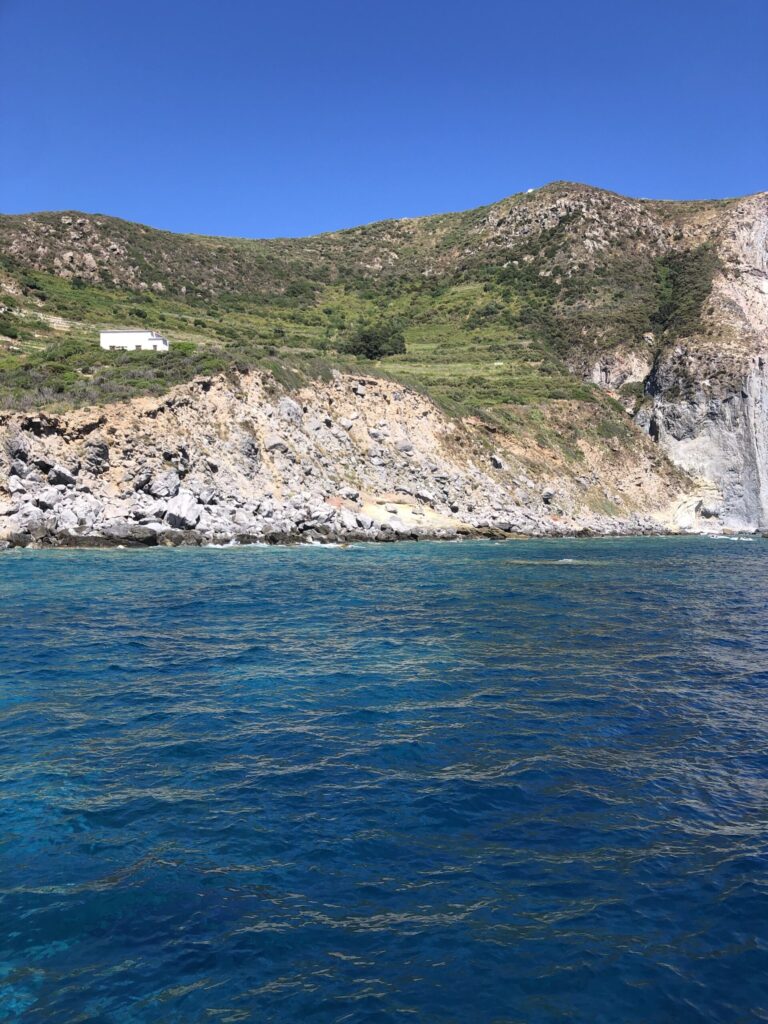
It sits on a remote edge of Ponza, where the land drops sharply into the sea and access is never immediate. There is no road that brings you here. You walk for about forty minutes along a rough path through wild Mediterranean brush, or you arrive by boat, carefully navigating the rocks that seem to guard the coastline. It asks something of you before you even arrive, and that effort feels like part of the experience.
And that is exactly why what grows here matters.
A Vineyard Rooted in Time
The story begins in 1734, when the island was being repopulated under Carlo di Borbone. Among those who arrived was Pietro Migliaccio, a farmer from Ischia, who was assigned a stretch of land at Punta Fieno.
Not all land on Ponza was equal. Much of it was raw, difficult, and untouched. And yet, by a quiet stroke of luck, Migliaccio was given the only area that had already been cultivated with vines. It was not something he created, but something he recognized and chose to continue.
He planted varieties that still define the wine today: Biancolella, Forastera, Guarnaccia, Aglianico, Piedirosso. Over time, those vines adapted to the land, pushing deeper into the volcanic soil, shaped year after year by wind, sun, and salt.
What is remarkable is not just that they survived, but that they never left.
These vineyards are now over three hundred years old. Not symbolic, not reconstructed, but continuous. Living roots that have remained in place through generations, through abandonment and return, through everything that has reshaped the island around them. There are very few places in Italy where that kind of continuity still exists.
Ponza is not a gentle landscape. It is volcanic, steep, and exposed, surrounded on all sides by the Tyrrhenian Sea. The land does not offer itself easily, and nothing here grows without effort.
At Punta Fieno, those conditions are felt more intensely. The terraces are carved into rock, holding on just enough to make cultivation possible. The sun is constant, the wind never really settles, and the air carries a trace of salt that becomes part of everything.
The vines respond to this environment in a way that cannot be replicated elsewhere. The wine that comes from them is mineral and precise, with notes of citrus, white flowers, and Mediterranean herbs. It carries the character of the place so clearly that it feels almost immediate, as if the landscape itself has been translated into something you can taste.
A Fragile Survival
There was a time when all of this was close to disappearing.
As the island changed and people left, parts of Ponza were abandoned, and Punta Fieno was among them. The terraces began to collapse, the land grew wild, and the vines were left largely unattended, surviving more out of resilience than care.
In the early 2000s, Emanuele Vittorio, a descendant of the Migliaccio family, returned to this stretch of land. What he found was not a functioning vineyard, but something on the edge of being lost.
He chose to rebuild it.
The process was slow and deliberate. The land had to be cleared, the terraces restored, the vines brought back into a rhythm that had been interrupted. It was not about scaling production or modernizing the process, but about preserving what was already there and allowing it to continue.
What emerged was not something new, but something reawakened.
Why It Matters
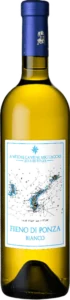
Fieno di Ponza – Antiche Cantine Migliaccio
Fieno is not just a wine. It is a place that has endured, and a way of working that has resisted being simplified.
In a world where so much has become predictable, optimized, and easy to access, Punta Fieno remains the opposite. It requires time, effort, and a willingness to step slightly outside of comfort. But in return, it offers something that feels increasingly rare: a direct connection to land, to history, and to the people who have chosen to stay tied to both.
When you finally sit there, with a glass of Fieno in your hand, the context becomes clear. This is not just about what you are tasting, but about everything that allowed it to exist in the first place.
Some places are meant to be seen. Others are meant to be reached.