
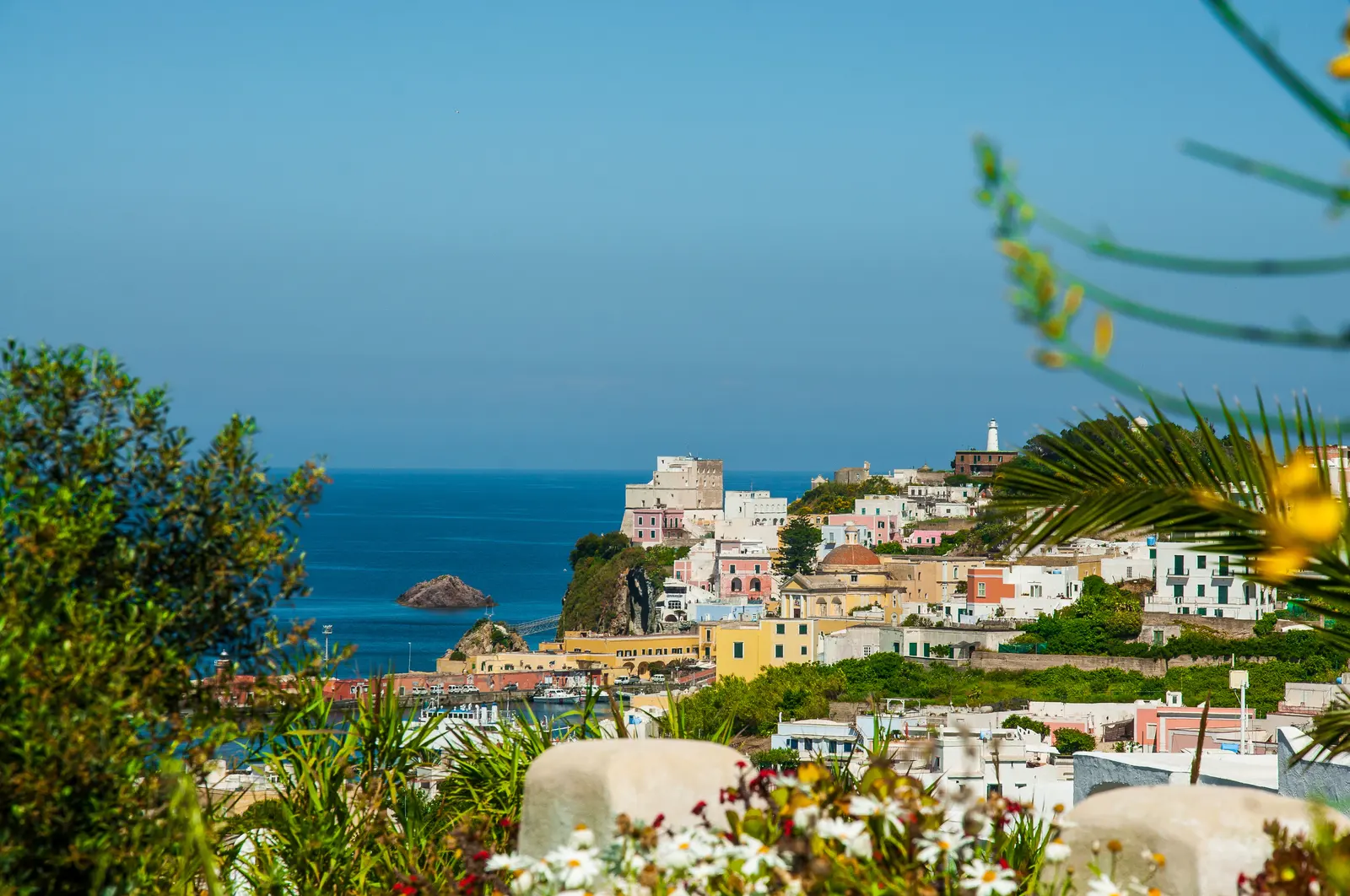
Ponza Island, the one Italians keep to themselves.
A crescent of pumice and yellow houses.
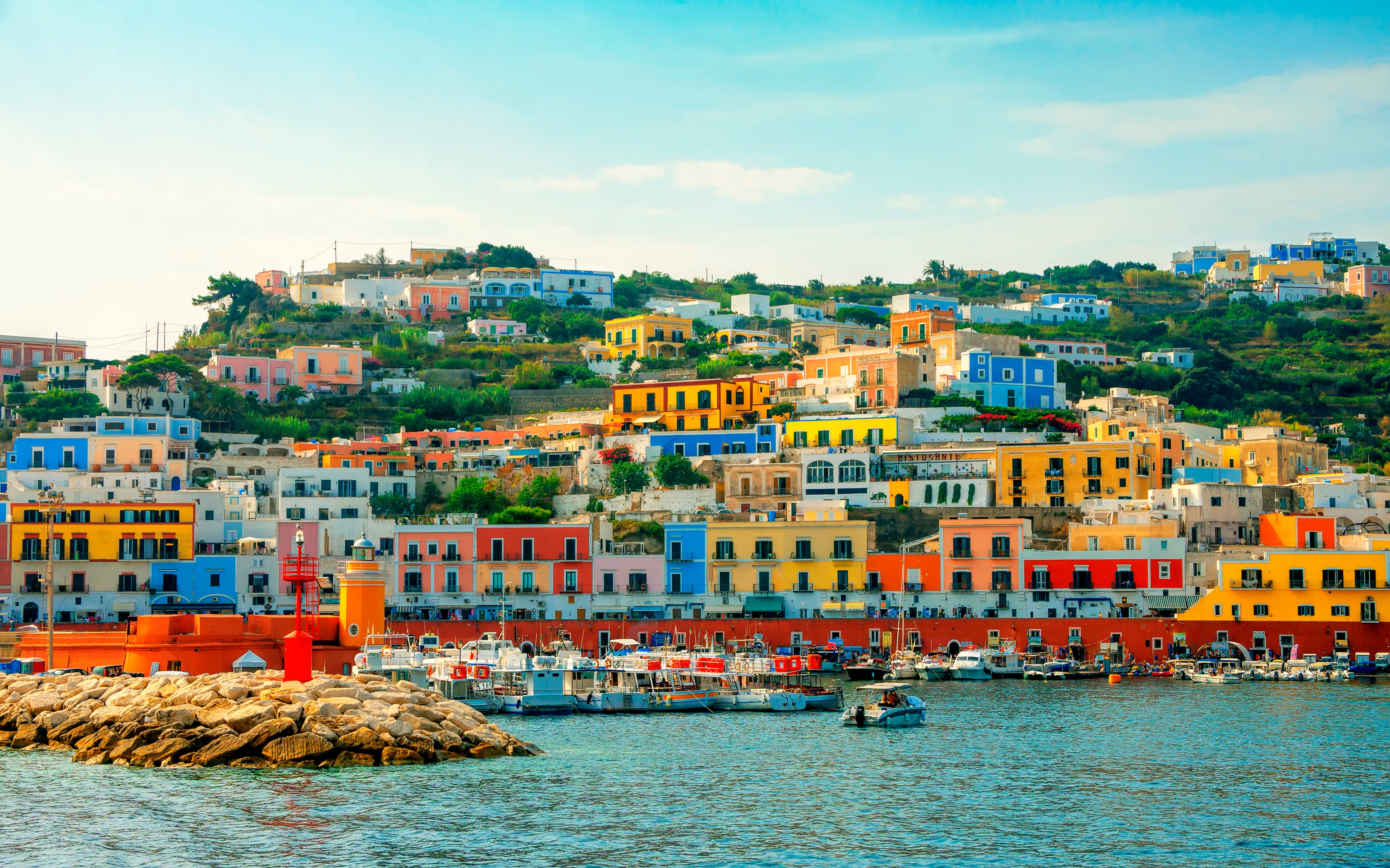
Ponza is the largest of the Pontine Islands, a six-island volcanic archipelago that surfaces in the Tyrrhenian Sea between Rome and Naples. The island is small: roughly 7 km long, never more than 2 km wide, and shaped like a dolphin. Its sister islands (Palmarola, Zannone, Ventotene, Santo Stefano, and tiny Gavi) are visible from the higher walks.
The shape is volcanic. The whole archipelago was sculpted by undersea eruptions and collapses over the last few hundred thousand years; Ponza Porto itself sits in a naturally curved volcanic basin. The rock is pale pumice and tuff; in late-afternoon light it goes almost gold.
The history is layered. Prehistoric settlements first, then Phoenicians, Greeks, and a Roman colony — Emperor Augustus exiled his daughter Julia here in 2 BCE, and the Romans farmed murene (moray eels) in the sea-caves now called the Grotte di Pilato, still visible from the water; built an amphitheatre that’s now overgrown above the port; and cut the tunnel to Chiaia di Luna that’s still visible today. Most of the houses you see in Ponza Porto were built in the mid-to-late 1700s under the Bourbon Kingdom of the Two Sicilies, when Neapolitan families were invited to repopulate the island. That dialect — Ponzese, a child of Napoletano — is still what older residents speak among themselves.
Ponza’s also been a famous place of exile, from Roman times through the end of World War II. Mussolini was briefly held here in 1943 after his arrest — the bright-yellow building with green shutters near Santa Maria beach is the room where he was kept.
Around 3,300 people live on the island year-round (Tuttitalia / ISTAT). The community is small and tight-knit, with the local businesses you’d expect of a working island. Tourist season runs from May through early October. In August the population swells dramatically with Roman day-trippers and weekly renters. June and September are the better months.
By sea, from a handful of mainland ports. Anzio is the easiest from Rome.
Ponza has a heliport but no commercial airport, so you arrive by sea. The mainland ports that serve the island are Anzio, Formia, Terracina, Civitavecchia, Naples, and (seasonally) San Felice Circeo. Each port runs a different mix of services. Anzio is the fastest and most direct option from Rome, which is why most Rome-based travellers use it.
Anzio sits an hour south of Rome by train (Trenitalia regional from Roma Termini, around €8 each way). The port is about a 15-minute walk from the station. Anzio is served only by fast ferries (operated by Laziomar); the crossing to Ponza takes about 70 minutes and costs roughly €60 round-trip per adult.
Formia is the primary year-round port and offers both fast ferries and conventional ferries (operated by Laziomar). The conventional ferry from Formia is the longest regular crossing at around 3 hours. Terracina is served only by fast ferries (NLG). San Felice Circeo runs a seasonal fast ferry (Pontina Navigazione). Naples and Civitavecchia are useful if you’re already in Campania or further north on the Tyrrhenian coast.
A note that comes up often: only the conventional ferries take cars. Every fast ferry is passenger-only. And cars on Ponza are more trouble than they’re worth: the roads are narrow, parking is non-existent in the port, and a scooter or your feet will do everything you need.
The four beaches you’ll hear about.
Most of Ponza’s coves are best reached by boat. The four below are the names every captain and every Roman summer-house owner will mention first.
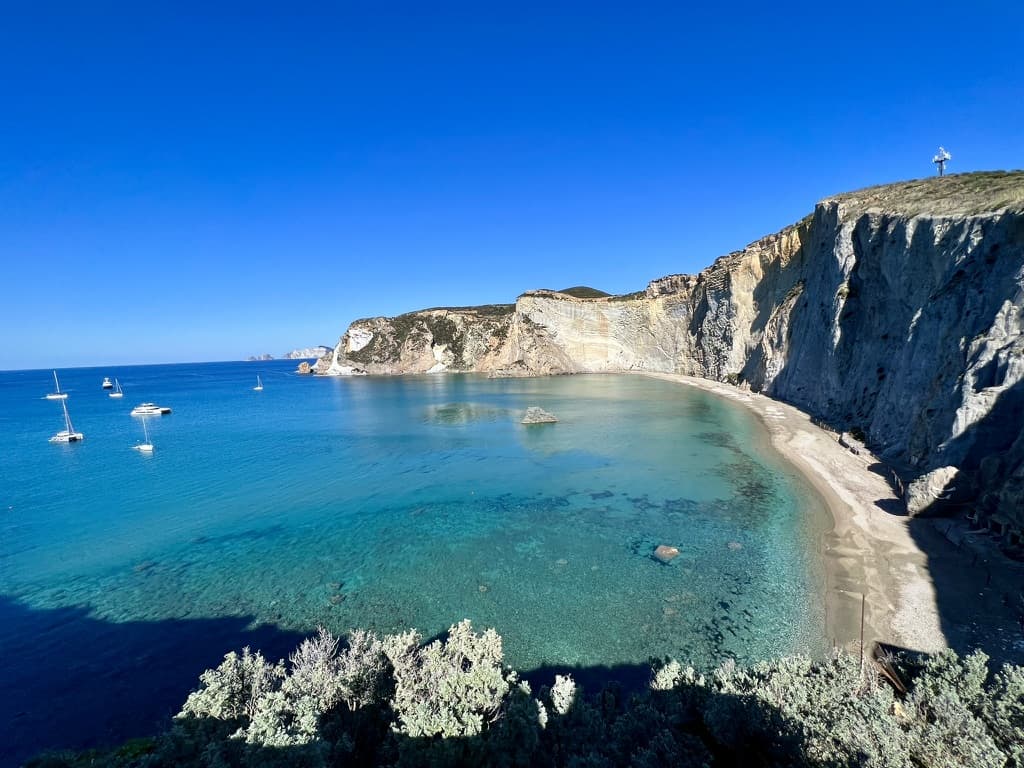
Chiaia di Luna
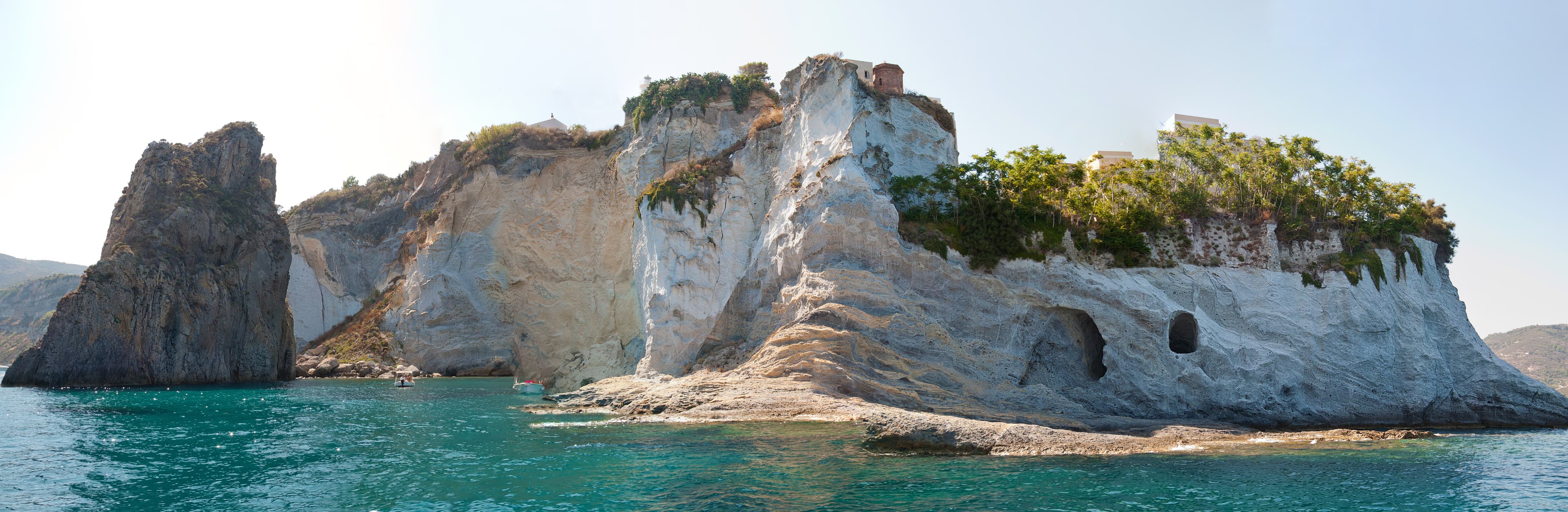
Ponza's most photographed beach sits under intensely vertical, golden-white cliffs (the colour gives the cove its name: chiaia di luna, moonrock beach). The Romans cut a tunnel from the port to reach it, still visible at the far end of the sand. The tunnel has been closed to walkers for years now because of rockfall, and the beach itself has been closed for safety in many recent seasons — Chiaia di Luna is best seen from the water; landing or access may be restricted. Every boat tour pulls in offshore for a swim and the view. Sunset, full moon, no contest.
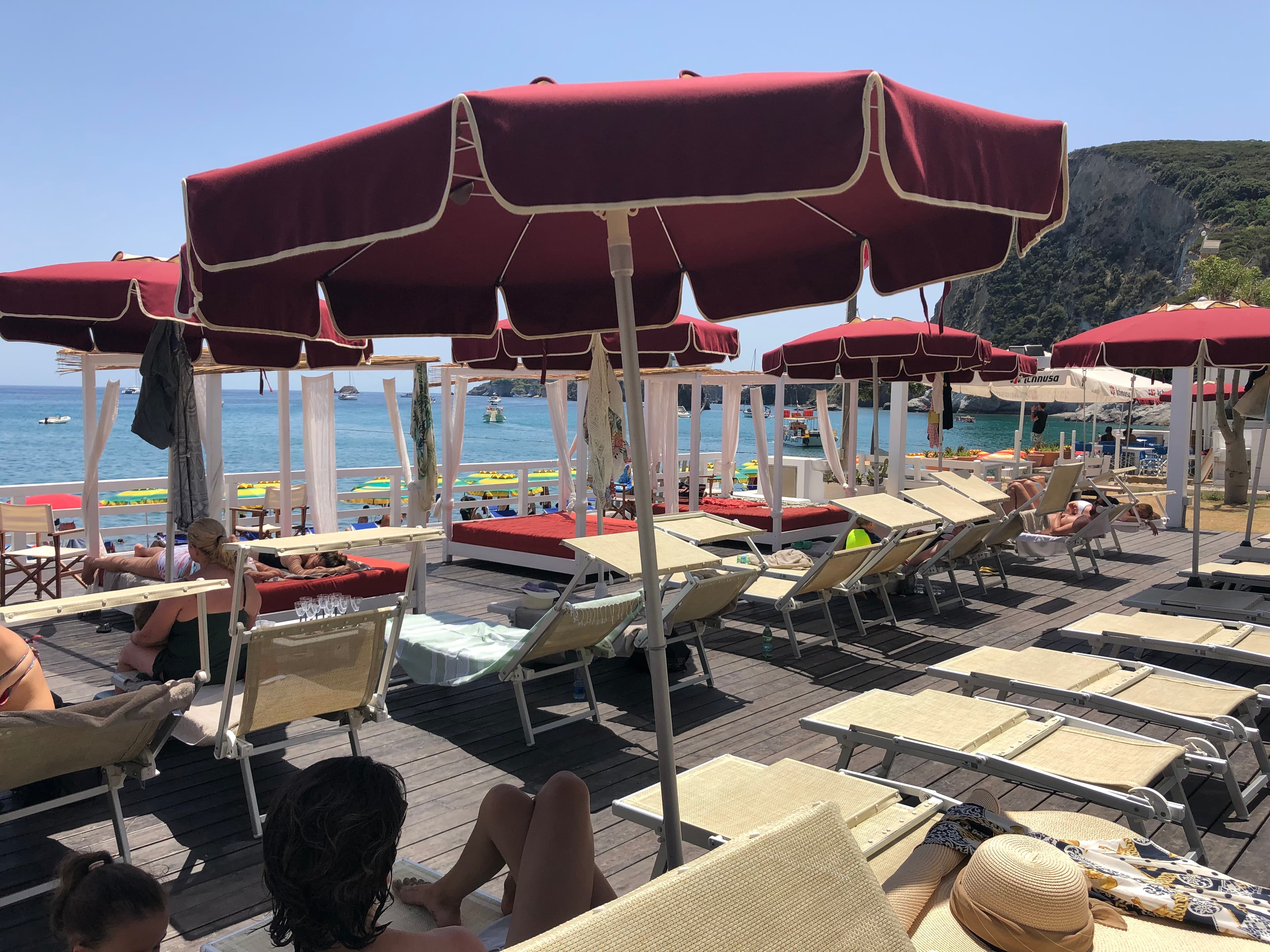
Frontone
On the opposite side of the island from Chiaia di Luna, Frontone is Ponza's social beach: long, sandy, easy water entry, two restaurants on the sand (one of them famous for its evening aperitivo). The easy way to reach it is the short water-taxi ride from Ponza Porto. A footpath down from Campo Inglese exists, but it's a significant walk and not the recommended option. Sun loungers are bookable in summer; recommended in August.
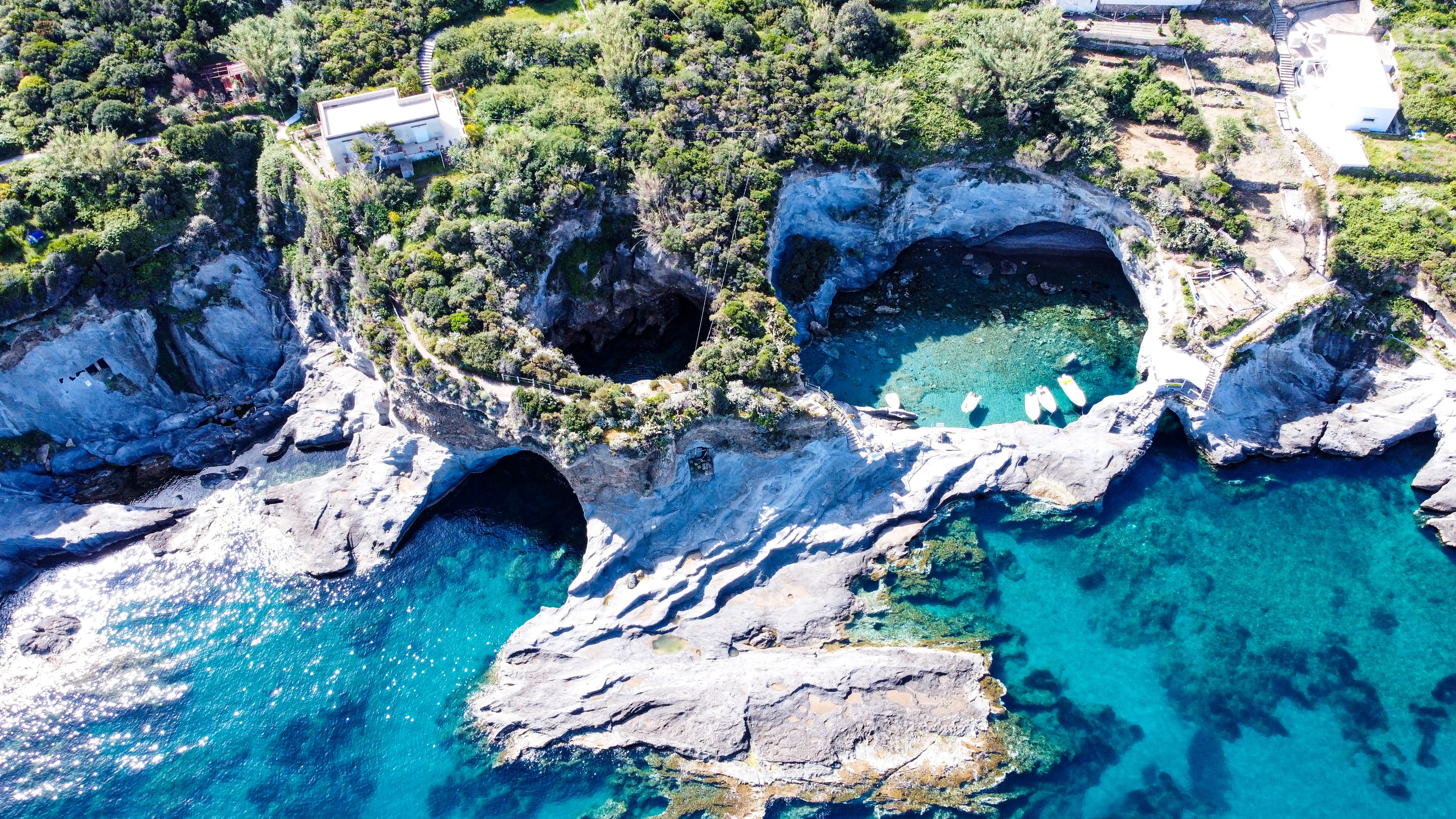
Cala Feola & the natural pools
Up at the Le Forna end of the island. Cala Feola is the small swimming beach; just along the rocks are the Piscine Naturali — natural pools sculpted into the volcanic rock by collapsing sea caves. The water inside is sheltered and clear, perfect for kids and weak swimmers. You reach it by walking down more than 300 stone steps from the road above. There's a tiny beach bar at the bottom for lunch.
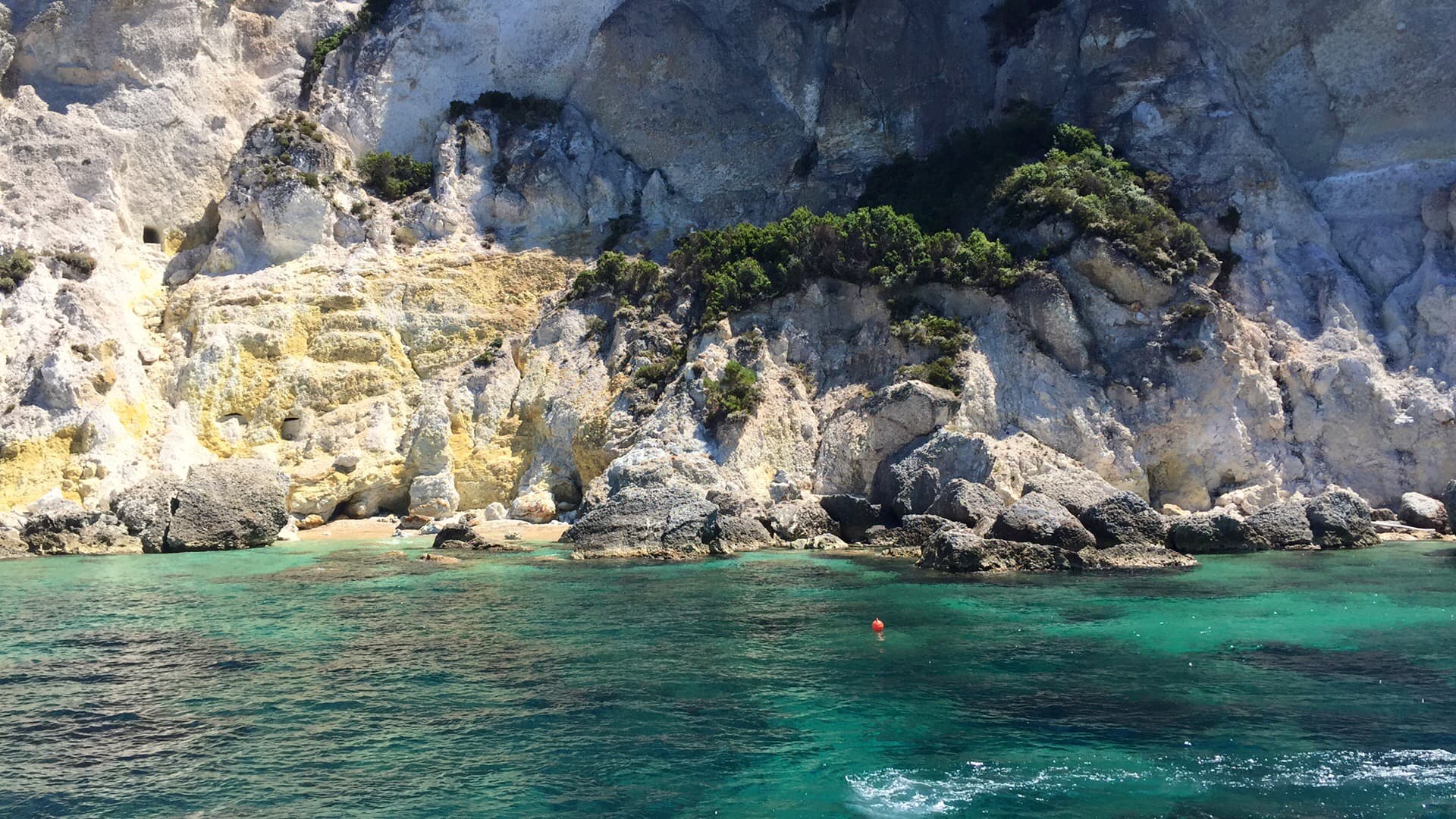
Cala Felci
On the northwestern side of the island, reached by boat. Cala Felci is best known for the bright yellow sulfur deposits streaking the cliffs above, the colour comes from Ponza's volcanic chemistry and is one of the island's most distinctive sights from the water. Local tradition holds that the sulfur is good for the skin. The cove itself is smaller and quieter than Frontone, better for swimming and snorkelling than lounging.
Ponza has many additional coves, sea caves, and swimming spots best explored by boat. The boat tour is how most visitors see them.
Boat tour first. Everything else, second.
The unspoken rule on Ponza: you do the boat tour on day one. Most of the coast (the grottoes, the swimming coves, the cliffs you can only really see from the water) is unreachable on foot. A typical 5-hour circumnavigation with a local skipper includes 4 or 5 swimming stops and threads about two dozen named landmarks. Exact stops vary with sea conditions on the day, but the regulars include the Grotte di Pilato (Roman sea-caves built as murenai, fish tanks for moray eels, with the ventilation tunnels still visible), the Faraglioni della Madonna sea-stacks marked by an ancient Roman bonfire-lighthouse, the rare tortoise-shell lava patterns at the Calzone Muto stacks, and the Arco Naturale, a sea-stack hollowed by wind and water that local tradition says will grant a wish if you swim through.
The Faro della Guardia at the south tip is one of Ponza’s great landmarks. The lighthouse sits on a dramatic offshore sea stack (a faraglione), with Monte Guardia rising above and behind it. At 280 m, Monte Guardia is the highest point in the Pontine Islands. The light is an important navigation marker for this stretch of the Tyrrhenian, visible up to 24 nautical miles out (Casale del Giglio). The land path up to the area has been in poor condition or restricted in recent years (FAI), so check local conditions before attempting it; in season, most visitors see the lighthouse from the boat tour. Divers should ask about the wreck of LST 349, an American WWII landing-ship-tank that sank in a storm off Punta del Papa in 1944 on its way back from Anzio. It sits around 20–26 m down (Ponza Diving) and is one of the Tyrrhenian’s better dives.
Take an early-morning day-trip to Palmarola, the uninhabited sister island where ninety per cent of the boats anchored in summer belong to Italians who would rather you didn’t know it exists. Back on Ponza, end the evening with aperitivo on Corso Carlo Pisacane, the waterfront promenade above the port. The Bourbon-era arcades light up gold against the pastel houses, and the fishing boats start coming in. It’s the most photographed moment on the island, and it doesn’t need a camera.
One practical note for visitors staying at the northern end of the island: taxis are available. They aren’t cheap, but the terrain and distances often make them worthwhile, especially in the evening or with luggage.
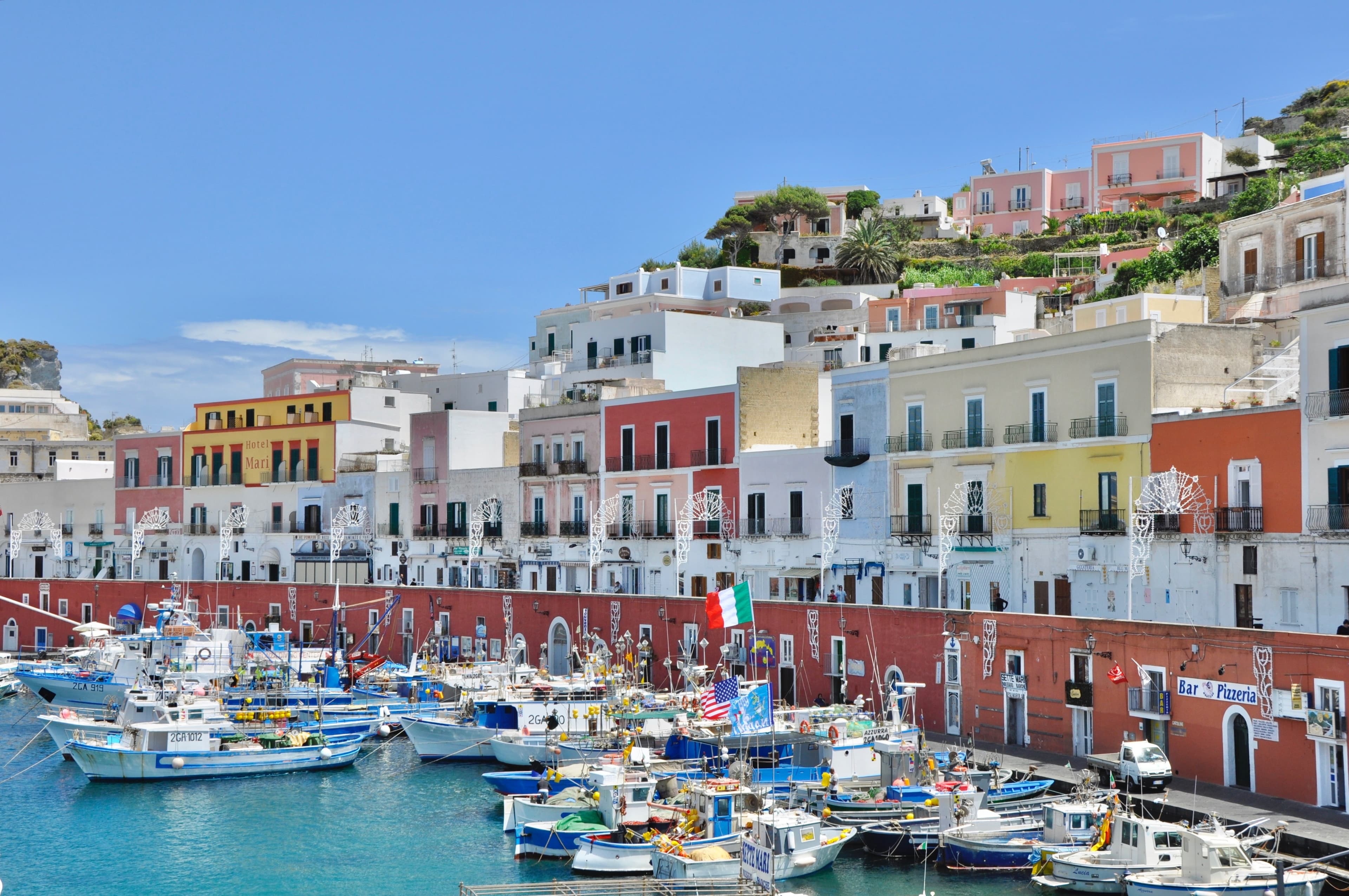
Three neighbourhoods, three different days.
Ponza is small enough that nowhere is far — the island bus covers the whole length in 20–30 minutes, longer in summer traffic — but where you base yourself shapes the rhythm of your day. Three honest choices, no hotel listings (the good places are mostly small, family-run, and best booked direct or through a local). One island-wide thing to know: freshwater is limited and much of the island depends on delivered and stored water, so showers tend to be short and considerate.
The harbour. The default.
Where the ferries dock, where most B&Bs cluster, where the evening passeggiata happens. Walk to a dozen restaurants, the pharmacy, the ATM. Loudest in August. The right choice for first-timers.
The quiet north end.
Up at the natural pools. Quieter, more residential, fewer restaurants. You need the island bus or a scooter to get back to the port. Perfect for a slow stay where you don't want to be near the action.
The middle ground.
Mid-island, between port and Le Forna. A few small hotels, residential pace, a couple of trattorias. Bus access in both directions. Quiet but not isolated. Underrated.
Accommodation is limited and Italian families repeat-book yearly — book early for July and August. May, June, and September are easier on both availability and price.
Fish that landed an hour ago. Wine you can’t buy on the mainland.
Ponza eats off its own boats. Spaghetti alle vongole made with clams the chef bought at the morning market. Linguine ai ricci, when the sea urchins are in season. Pesce all’acqua pazza (“fish in crazy water”), the lightest, simplest preparation Italy has ever invented, and the one that lets the fish actually taste like itself. If you see Lenticchie di Ponza on a menu, they’re worth trying — small, flavorful lentils that have been cultivated on the island for generations and remain one of Ponza’s most distinctive local specialties. Coniglio alla Ponzese (rabbit with white wine and rosemary) is the classic non-fish dish. For something baked, ask for Casatiello Ponzese, the island’s rich savoury Easter loaf, often available beyond the holiday in local bakeries.
Ponza’s signature wine is Fieno di Ponza from Antiche Cantine Migliaccio — Biancolella di Ponza and Forastera grown on the steep terraces around Punta Fieno. Another bottle to know is Faro della Guardia by Casale del Giglio, a pure Biancolella di Ponza named for the island’s southern lighthouse. Both taste like wind, sea salt, and the kind of patience nobody writes about in wine magazines.
The food writer Katie Parla covered Ponza in her cookbook Food of the Italian Islands. We wrote our take on what the book gets right.
Where to eat: the trattorias along Corso Carlo Pisacane (the waterfront promenade) for the classic view; the family-run restaurants up at Le Forna for a quieter lunch with views; whichever small port kitchen happens to have the day’s catch on the blackboard. Reservations are recommended in August, essential anywhere with sea-view tables.
June or September. That’s the answer.
Water still cold (~18°C), wind possible, but the island is empty and prices are lowest. For people who’d rather hike than swim.
The sweet spot. Water swimmable (21°C+), ferries on full schedule, restaurants open, no crowds. The locals’ favourite month.
Hot, busy, alive. The Roman families arrive. Book restaurants ahead. Water at ~24°C. The island feels its full energy.
Peak Ferragosto chaos in the first half — the entire country on holiday. Vibrant if you love it, exhausting if you don’t. Prices double.
The other sweet spot. Italians go home, restaurants still open. Soft light. The island exhales.
Ferries thin out after late October. A few warm beach days remain. Hotels start to close. Hauntingly beautiful, if you’re prepared.
Most things closed; a few hotels and one or two restaurants stay open for residents. Walkers’ paradise. Not for first-timers.
Italian families come for the long weekend. Town wakes up briefly, then quiets again until May. A surprisingly nice time to overlap.
The hard way is fine. The easy way is a tour.
The honest truth: most international visitors don’t have the Italian, the local fixers, or the calendar slack to plan the ferries, the boat tour, the right beach, and the lunch reservation in the right cove. We do this 50+ days a year. We handle every piece — train tickets, ferry reservations, the captain’s number — so you wake up in Rome and go to bed having spent a perfect day on Ponza.
 Rome → Anzio → Ponza, sorted
- Private boat with a local skipper
- Lunch at the right cove
- English-speaking team, all day
Ponza Island — the questions that come up.
We answer these on WhatsApp every week — collected here so you can find what you need without typing.
Written by the Open Up Italy team, who have spent twenty years building day trips on Ponza. Facts cross-checked against our captains’ on-water reference document and the following published sources, audited May 2026:
- Treccani — geography & volcanic origin
- Tuttitalia / ISTAT — population data
- Pro Loco Ponza — Grotte di Pilato as Roman murenaio
- FAI — Faro della Guardia access & condition
- Casale del Giglio — lighthouse range (24 nm) & Biancolella wine
- Antiche Cantine Migliaccio — Fieno di Ponza wine
- Ponza Diving — LST 349 wreck
- Italia.it — Chiaia di Luna
- Vivi Ponza — local tourism reference
Ferry schedules, beach access (Chiaia di Luna in particular), lighthouse path condition, and operator routes change seasonally — verify the current state before booking.

Pick a day, pack a swimsuit.
We’ll handle the trains, the ferries, the boat, the lunch, and the captain who knows where the dolphins sometimes show. You handle the swimming.